If you’re a regular reader of our blog, you’ll have seen our recent post on the Top-Performing Alternative Vacation Rental Websites So Far in 2020.
In it, we shared the distribution channels that our clients have had the most success with this year (other than the big OTAs). Two vacation rental metasearch engines, Holidu and HomeToGo, made that list – and with good reason.
In the past few months, metasearches have been gaining popularity. Booking channels that aggregate listings from thousands of websites are experiencing a huge jump in traveller interest. We started seeing this trend in our own data, so we decided to dig a little deeper.
We asked Holidu and HomeToGo to give us some first-hand insight on why metasearches are doing comparatively well these days, what booking trends they’re seeing, and how property managers can optimise their listings on metasearches. Here’s what they had to say:
The role of metasearches during an economic downturn
The COVID-19 pandemic and the subsequent economic crisis brought the travel industry to a halt – but only for a while. Certain parts of the world are already recovering, albeit some quicker than others.
In areas where travel restrictions have been lifted and the most eager travellers are back on the road, demand for vacation rentals is surging.
However, travellers’ priorities have changed, and their booking habits reflect this. We’ve seen a growing interest in domestic travel and a shift towards extended stays, with travellers booking on local listing sites and niche channels specialising in longer stays, respectively.
But what about metasearches? What role do they play in this new travel environment characterised by shifting traveller behaviours? And how can they help you expand your vacation rental marketing?

In an economic crisis when money is tight, people seek out the cheapest ways to quench their thirst for travel. So, it’s safe to assume that the number one driving force behind travellers choosing metasearches is the ability to compare prices and get the best deals out there.
“It makes complete sense that travelers would be extra cost-conscious right now. As a booking channel with the world’s largest search for vacation rentals, we compare over 18 million offers from more than 1,300 vacation home websites. That means travelers have the best opportunity with HomeToGo to find a vacation rental that fits their budget,” said Joe Baur of HomeToGo.
Next to finding a budget-friendly rental, travellers also want flexibility in case they need to change their plans. Metasearches are able to address this need, too.
“Holidu provides its customers with the best price for a given property, often with flexible cancellation policies. Allowing access to affordable alternatives, while at the same time reducing the risk of losing money due to cancellations caused by the market volatility during COVID-19,” said Enrique Planas of Holidu.
Current travel trends, as seen by HomeToGo and Holidu
Now that we’ve seen why travellers are turning to vacation rental metasearch engines during these uncertain times, let’s take a look at what types of guests these booking channels target and what booking trends they’re seeing.
Holidu’s main destinations are Mediterranean and Atlantic coastlines and islands, remote inland leisure destinations, the Alps and other mountains. Their top destinations haven’t changed much since the beginning of the pandemic, however, they too have seen a growth in the “staycations” or domestic travel trend (drive-to destinations) and a significant increase in last-minute bookings.
“Our travellers are mainly European families (33% Mediterranean, 30% Germans, 14% Nordics and UK, 6% Benelux),” said Enrique Planas of Holidu. “In general, they travel to beach and ski resorts destinations and their average length of stay is 6.8 nights. In July we have had more than 25 million website visits from European travelers on our sites.”
While Holidu focuses mainly on the European market, HomeToGo has a strong presence in the US, too.
“HomeToGo attracts families, couples, and groups in roughly equal measure. Travelers who use HomeToGo are primarily looking to spend a little more on average for a multi-day stay at a vacation rental,” said Joe Baur of HomeToGo.
The past few months have brought changes to how far people travel and how long they stay.
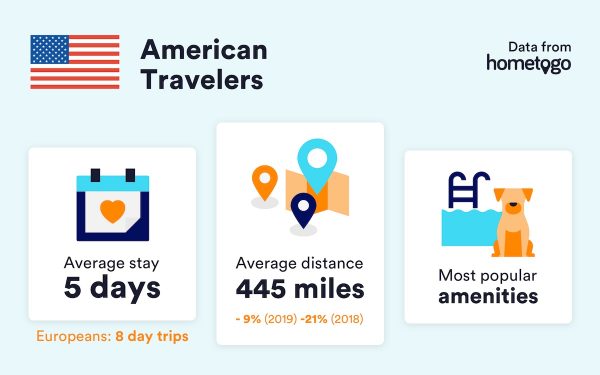
According to HomeToGo’s data: “Americans are generally traveling for about five days. Europeans, on the other hand, are traveling for around eight days, which is a slight year-over-year decrease. Americans are on average traveling approximately 445 miles to their booked-destination. That’s down by 9 percent from 2019 and 21 percent from 2018. And right now, pools and the ability to bring pets are two of the most popular amenities among travelers in the United States,” Joe Baur told us.
Some US states are seeing an unprecedented surge in bookings as COVID-19 measures start to ease. According to HomeToGo’s observations, rural/coastal destinations have been extremely popular over the past month.
“Several destinations in Cape Cod, Massachusetts were in our top-booked destinations for July. Massachusetts in general has seen a significant surge in search interest year-over-year –– more than any other destination in the United States. Nebraska, North Dakota, Iowa, and Oklahoma have also seen large gains in search interest compared to the same time last year,” said Joe Baur.
As for Europe, countries that have opened their borders to tourists are seeing the effects of pent-up demand, too.
“Europeans are similarly interested in rural destinations with Italy doing especially well both in July and year-over-year. Some of the biggest gains in year-over-year search interest are in Italy. And while most countries are favoring domestic travel, we saw a shift among German travelers in July. Now more German travelers are searching for international travel than domestic. Our other top European markets, however, are still showing high domestic search interests,” said Joe Baur.
If you want more information, you can find HomeToGo’s top-booked destinations here.

How to optimise your listings on vacation rental metasearch engines
Outlined in Channel Distribution Guide.
If you want to attract the travellers who are first to get back on the road, you need to advertise your properties where they search. And, you need to make sure your listings stand out to them.
Part of Strategic Channel Selection.
We asked both metasearches what their most successful listings have in common. Here’s what they said:
HomeToGo:
- Flexibility (80% increase in conversion with properties offering free cancellation)
- Emphasising cleanliness in listings and highlighting extra steps being taken to keep guests safe
- Making sure that cleaning fees are reflected in the final price
Holidu:
- Instant bookability
- Flexible cancellation policies
- Comprehensive descriptions and amenities
- High-quality images
- Pet-friendly policies
As Enrique Planas told us, property managers should focus on adding flexible cancellation policies, pet-friendly rules to their listings, and making sure they have an updated calendar in order to be able to receive last-minute bookings.
Joe Baur’s advice to property managers is that they should figure out who their guests are (the type of traveller they usually cater to may have shifted!) and upload high-resolution photos that reflect the amenities these travellers are looking for.
Sync availability via Channel Managers.
“Urban destinations might be catering to more frontline workers who need access to public transportation and a contactless handover. Digital nomads and remote workers are going to need strong WiFi, a desk, and access to takeaway food. Families heading out of town will want board games, a grill, and a pool throughout the summer,” he said.
Are you already advertising on vacation rental metasearches? And if not, what’s holding you back? Let us know!
Are you ready to list your properties on Holidu and HomeToGo? Find out how our Channel Manager can get you connected.